
Jaitley said govt would achieve 4.1% fiscal deficit target in FY15.
Analysts said the higher capex by PSUs, along with government spending, could trigger a capex revival for the corporate sector by the second half of FY17

There is a relation between pollution and climate change, the environment minister said, adding that 40 per cent of India's total power capacity will come from renewable sources before 2030.

In the current fiscal so far, retail inflation stabilised around 5 per cent, while wholesale price-based inflation averaged around 2.9 per cent during April-December.

With Deputy Governor Viral Acharya and another member Chetan Ghate voting for a status quo, RBI governor Shaktikanta Das and three others outvoted them for reduction in repo rate to 6.25 per cent from the existing 6.50 per cent.

As the Indian equities signed off 2019 on a remarkable note, the m-cap of BSE-listed companies rose by Rs 11,05,363.35 crore to Rs 1,55,53,829.04 crore.

Former prime minister Manmohan Singh said India is poised to take advantage of globalisation and engage in trade to finance its imports through exports.
Various global and domestic factors had a sizable impact on the performance of the Indian markets

Slight recovery in growth is expected only in July-September.

'The middle class you can hurt anytime. For revenues, politics, pleasure, anything,' notes Shekhar Gupta.

India must have a "contingency plan" in place to ring-fence the country's economy if the political showdown in the US leads to a default on its international monetary obligations, industry body Assocham said.


Industrialists affirm their belief that the adverse effects of demonetisation and the goods and services tax are finally over.
Taking advantage of the RBI's different accounting year, the Centre had started demanding an interim dividend till the time the latter's final balance sheet is prepared (usually in August). To address this anomaly, an expert committee led by former RBI governor Bimal Jalan had recommended aligning the RBI's financial year with that of the government.

'The middle class is already alienated.' 'If the stockmarket is destabilised, the BJP is finished; the party will lose in every town.' 'And if the stockmarket crash happens now, the BJP will not cross the 150 mark in 2019.'

The domestic unit had recovered to 68.65 in early trade on Friday as against Thursday's closing of 68.72.
.jpg)
India's economy grew 4.7 per cent in 2013-14, following an expansion of 4.5 per cent in 2012-13. In the fourth quarter of 2013-14, growth remained subdued at 4.6 per cent, mainly due to a decline in manufacturing and mining output.

'As the 1991 experience showed, the solution to a large trade deficit may be to open up the economy, not putting up protective walls,' points out T N Ninan.

Pressure on the government increased with the Reserve Bank of India's surprise move on Thursday to cut interest rates

If net forex outflows turn out to be relatively high in the next few years, the rupee could depreciate beyond Rs 80 to a dollar by 2022. The causal reasons could, for example, include unmet expectations of FPI and FDI investors about the performance of the Indian economy, sharp rise in prices of imported oil and decrease in FX remittances. The RBI has to ask itself whether guaranteeing future rupee-dollar exchange rates on FX forward contracts is a reasonable way to use its risk-bearing capacity, says Jaimini Bhagwati.

The economy is projected to clock 7.4 per cent growth.

Ahead of his government's first full year budget, Prime Minister Narendra Modi on Friday sought ideas from economists to attract investments, create jobs and finance infrastructure to put India back on high growth path.

Union Budget had projected the fiscal deficit at Rs 5.56 lakh crore.

'This solid verdict would further strengthen his resolve to drive forward the economic agenda to ensure that the fruits of the economic momentum continue to reach the poor, so visible during the last five years.'
Demonetisation hit informal sector hard and caused job losses which was not addressed by the budget, Moily said.

'India should take up defence manufacturing in a more serious manner and encourage greater private participation.'

The upcoming corporate results season and the approaching Union Budget kept investors on their toes

The government on Friday lowered its economic growth forecast.
Why do I want to bring corporate tax from 30 per cent to 25 per cent? I have to attract investment in this country -- not just international but domestic.

Pressure has been mounting on the Reserve Bank of India to cut interest rates in the wake of declining retail inflation and the need to fuel growth momentum. However, the RBI will have to do a tightrope walk as globally interest rates are inching upwards.

'Imran Khan hopes to fulfill the dreams of the founders of of Pakistan in establishing an Islamic Welfare State.' 'The grave situation of the economy makes realisation of this dream very difficult,' points out Colonel R N Ghosh Dastidar (retd).

Top losers in the Sensex pack on Friday included Bajaj Finance, ONGC, IndusInd Bank, PowerGrid, L&T, Axis Bank, NTPC, Bharti Airtel, HDFC, HDFC Bank and Kotak Mahindra Bank, falling up to 2.08 per cent.

'For the RBI, it is also strategic to allow the rupee to over-depreciate, then come and buy the rupee, and benefit from its appreciation. Speculators who have driven the rupee too low then make losses,' says Ashima Goyal.
A short war with Iraq could cost the world one percent of its economic output over the next few years and more than $1 trillion by 2010, Australian researchers said in a report

No need for extra stimulus, India to hit around 8 pct growth: adviser

Market experts on why the bulls will be on the rampage first thing on Monday after the scrapping of enhanced surcharge on FPIs and other measures to ease the systemic liquidity squeeze and boost demand. Prasanna D Zore reports.

The rupee had revisited the near 2-month low of 60.55 per dollar earlier in the session.

Market players say following the tax cuts, the market mood had changed from bearish to positive, which should help sustain the rally.
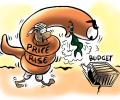
In absolute terms, fiscal deficit went up by 33.6 per cent in April-December 2017 and the revenue deficit by as much as 40.7 per cent compared to the same period the previous year, said Sudipto Mundle.

The stock market, the Survey felt, had run away from underlying real economy indicators and asked if this indicated rational confidence or irrational exuberance.
